

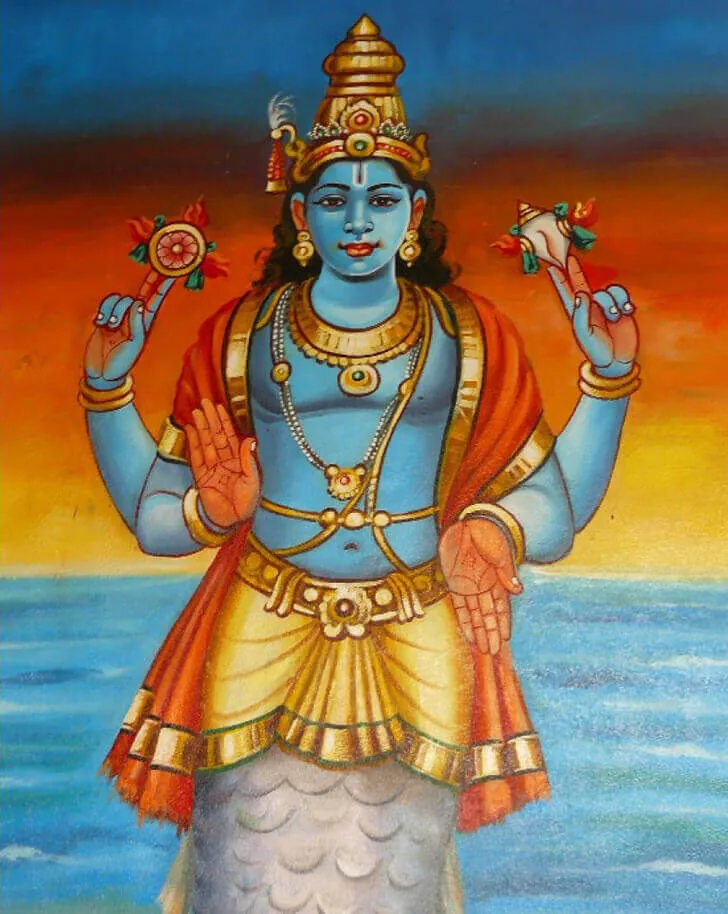
There are ten incarnations of Lord Vishnu. The first was in the form of a fish, called the Matsya avatar. According to the Matsya Purana, the story goes like this. At the start of the Satya Yuga, the world was destined to be destroyed by massive floods. Lord Vishnu decided to protect humanity from this catastrophe. He took the form of a fish, or Matsya, and entered a river on earth.
A king named Manu lived on the banks of the river that Lord Vishnu had entered in the form of a fish. While collecting water from the river, King Manu caught the fish in his vessel. When he was about to throw the fish back into the river, it pleaded with him not to. The king compassionately decided to keep the fish in his vessel. The next day, he was surprised to see that the fish had grown enormously. The fish continued to grow. The king moved it to a pond, then to the River Ganga, and finally, when it had outgrown everything, he placed it in the ocean.
The king realized that the fish was a divine and sacred being. The fish revealed itself to be Lord Vishnu and warned the king about the coming floods. He told the king that the floodwaters would submerge the whole world, killing all living beings, and that only King Manu could save humanity and preserve it in the new world.
The fish commanded King Manu to build a great ship and to gather in it all valuable people, plants, and animals of every species. The king began preparing to survive the coming disaster. When the floods came, the king and the chosen people, animals, and plants were safe inside the ship. He tried to steer the ship through the storm, but all in vain. Then Lord Vishnu, as Matsya the fish, steadied the ship from behind for seven days and seven nights. King Manu and all the beings on the ship were saved and lived in a new world.
Iconography: How Matsya Is Depicted
Matsya is usually shown in one of two ways. In some images he is a huge golden fish with a single horn on his head. In several Puranic tellings, King Manu tied his ship to this horn during the flood. In temple sculpture and paintings he is more often shown with the upper body of four-armed Lord Vishnu and the lower body of a fish.
In his four hands he holds Lord Vishnu's familiar emblems: the conch (shankha), the discus (chakra), the mace (gada) and the lotus (padma). Some paintings also show the Vedas being returned to Lord Brahma, which comes from another story linked to this avatar.
Symbolism and Lessons of the Matsya Avatar
According to the Bhagavata Purana, before the great flood a demon named Hayagriva stole the Vedas from Lord Brahma while he slept. Matsya killed the demon and restored the Vedas. For this reason devotees see the first avatar as the protector of sacred knowledge as well as of life itself.
- Compassion is rewarded: King Manu's kindness to a small fish that pleaded for his help began the rescue of the whole world.
- Preserving what matters: Manu was asked to save plants, seeds, animals and, according to tradition, the seven sages (Saptarishi). The story reminds us to protect life and knowledge for future generations.
- Faith in difficult times: when Manu could not steer the ship himself, the Lord carried it safely through the storm.
- A new beginning: the flood marks the end of one age and the start of another, with Manu as the father of the new humanity.
Temples, Matsya Jayanti and Thursday Worship
Temples dedicated mainly to Matsya are rare. The best known is the Sri Vedanarayana Swamy Temple at Nagalapuram in Andhra Pradesh, where the Lord is worshipped in the Matsya form. Matsya also appears in the Dashavatara panels carved on many Vishnu temples across India.
Matsya Jayanti is observed on the third day of the bright fortnight (Shukla Tritiya) of the month of Chaitra. Devotees believe the Lord appeared as the fish on this day, so they fast, read the Matsya story and visit Vishnu temples.
Thursday (Brihaspativar) is dedicated to Lord Vishnu and to Brihaspati, the guru of the gods. Reading the stories of Lord Vishnu's avatars is a common part of Thursday worship, and Matsya, the first, is a natural place to begin. Because Matsya saved the Vedas, his story sits well beside the worship of Brihaspati, who is honoured as the giver of wisdom. A simple Thursday practice is to offer yellow flowers, bananas and chana dal to Lord Vishnu and chant "Om Namo Bhagavate Vasudevaya".
भगवान विष्णु के दस अवतार हैं। पहला अवतार मछली के रूप में था, जिसे मत्स्य अवतार कहा जाता है। मत्स्य पुराण के अनुसार गाथा इस प्रकार है। सतयुग की शुरुआत में दुनिया का भारी बाढ़ से नष्ट होना तय था। भगवान विष्णु ने इस विनाश से मानवता की रक्षा करने का निश्चय किया। वे एक मछली अर्थात मत्स्य के रूप में परिवर्तित हो गए और पृथ्वी पर एक नदी में प्रवेश कर गए।
जिस नदी में भगवान विष्णु ने मछली के रूप में प्रवेश किया था, उसी नदी के तट पर मनु नाम का एक राजा रहता था। राजा मनु ने नदी से पानी भरते समय मछली को अपने बर्तन में पकड़ लिया। जब वह मछली को वापस नदी में फेंकने वाला था, तब मछली ने उससे विनती की कि उसे वापस नदी में न फेंके। राजा ने दया करके मछली को अपने बर्तन में रखने का निर्णय लिया। अगले दिन वह यह देखकर हैरान रह गया कि मछली बहुत बड़ी हो गई थी। मछली बढ़ती ही रही। राजा ने उसे पहले एक तालाब में, फिर गंगा नदी में रखा, और अंत में जब वह हर जगह के लिए बहुत बड़ी हो गई, तो उसे समुद्र में छोड़ दिया।
राजा को अनुभव हुआ कि मछली एक पवित्र और दिव्य प्राणी है। तब मछली ने स्वयं के भगवान विष्णु होने का रहस्य प्रकट किया और राजा को आने वाली बाढ़ के बारे में बताया। उन्होंने राजा से कहा कि बाढ़ का जल पूरी दुनिया को डुबो देगा, जिससे सभी जीवों की मृत्यु हो जाएगी, और केवल राजा मनु ही मानवता को बचाकर नई दुनिया में सुरक्षित रख सकते हैं।
मछली ने राजा मनु को एक विशाल जहाज बनाने और उसमें सभी मूल्यवान लोगों, पौधों और प्रत्येक प्रजाति के जानवरों को इकट्ठा करने की आज्ञा दी। राजा ने आने वाली आपदा से बचने की तैयारी शुरू कर दी। जब बाढ़ आई, तो राजा और चुने हुए लोग, जानवर और पौधे जहाज के अंदर सुरक्षित थे। राजा ने तूफान में जहाज को संभालने का प्रयास किया, पर सब व्यर्थ रहा। तब मछली के रूप में भगवान विष्णु सात दिनों और सात रातों तक जहाज को पीछे से संभाले रहे। राजा मनु और जहाज के सभी प्राणी बच गए और एक नई दुनिया में रहने लगे।
मत्स्य अवतार का स्वरूप
मत्स्य अवतार को सामान्यतः दो रूपों में दिखाया जाता है। कुछ चित्रों में वे एक विशाल सुनहरी मछली के रूप में दिखते हैं, जिसके सिर पर एक सींग होता है। कई पौराणिक कथाओं के अनुसार प्रलय के समय राजा मनु ने अपनी नौका इसी सींग से बाँधी थी। मंदिरों की मूर्तियों और चित्रों में उनका ऊपरी भाग प्रायः चार भुजाओं वाले भगवान विष्णु का और निचला भाग मछली का दिखाया जाता है।
उनके चारों हाथों में भगवान विष्णु के परिचित चिह्न होते हैं: शंख, चक्र, गदा और पद्म (कमल)। कुछ चित्रों में उन्हें भगवान ब्रह्मा को वेद लौटाते हुए भी दिखाया जाता है, जो इस अवतार से जुड़ी एक अन्य कथा पर आधारित है।
मत्स्य अवतार का प्रतीकात्मक अर्थ और शिक्षा
भागवत पुराण के अनुसार प्रलय से पहले, जब भगवान ब्रह्मा निद्रा में थे, तब हयग्रीव नामक एक असुर उनसे वेद चुरा ले गया। मत्स्य भगवान ने उस असुर का वध करके वेदों को वापस लौटाया। इसी कारण भक्त पहले अवतार को जीवन के साथ-साथ पवित्र ज्ञान का रक्षक भी मानते हैं।
- दया का फल: सहायता की विनती करने वाली एक छोटी-सी मछली पर राजा मनु की दया से ही पूरी सृष्टि की रक्षा की शुरुआत हुई।
- जो मूल्यवान है, उसे सहेजना: मनु को पौधों, बीजों, जीव-जंतुओं और परंपरा के अनुसार सप्तर्षियों को बचाने का दायित्व मिला। यह कथा जीवन और ज्ञान को आने वाली पीढ़ियों के लिए सुरक्षित रखने की सीख देती है।
- कठिन समय में आस्था: जब मनु स्वयं नौका नहीं संभाल पाए, तब भगवान ने उसे सुरक्षित रूप से तूफान के पार पहुँचाया।
- नई शुरुआत: प्रलय एक युग का अंत और दूसरे युग का आरंभ है, जिसमें मनु नई मानव जाति के आदि पुरुष बनते हैं।
मंदिर, मत्स्य जयंती और गुरुवार की पूजा
मुख्य रूप से मत्स्य अवतार को समर्पित मंदिर बहुत कम हैं। इनमें सबसे प्रसिद्ध आंध्र प्रदेश के नागलापुरम में स्थित श्री वेदनारायण स्वामी मंदिर है, जहाँ भगवान की पूजा मत्स्य रूप में होती है। इसके अलावा भारत के अनेक विष्णु मंदिरों में बने दशावतार शिल्पों में भी मत्स्य अवतार दिखाई देते हैं।
मत्स्य जयंती चैत्र मास के शुक्ल पक्ष की तृतीया को मनाई जाती है। भक्तों की मान्यता है कि इसी दिन भगवान मछली के रूप में प्रकट हुए थे, इसलिए वे व्रत रखते हैं, मत्स्य अवतार की कथा पढ़ते हैं और विष्णु मंदिरों में दर्शन करते हैं।
गुरुवार अर्थात बृहस्पतिवार भगवान विष्णु और देवगुरु बृहस्पति को समर्पित है। भगवान विष्णु के अवतारों की कथाएँ पढ़ना गुरुवार की पूजा का एक आम हिस्सा है, और पहला अवतार होने के कारण मत्स्य अवतार से शुरुआत करना स्वाभाविक है। मत्स्य भगवान ने वेदों की रक्षा की थी, इसलिए उनकी कथा ज्ञान के दाता माने जाने वाले बृहस्पति देव की पूजा के साथ सहज रूप से जुड़ती है। गुरुवार को भगवान विष्णु को पीले फूल, केले और चने की दाल अर्पित करना और "ॐ नमो भगवते वासुदेवाय" का जाप करना एक सरल और प्रचलित विधि है।