

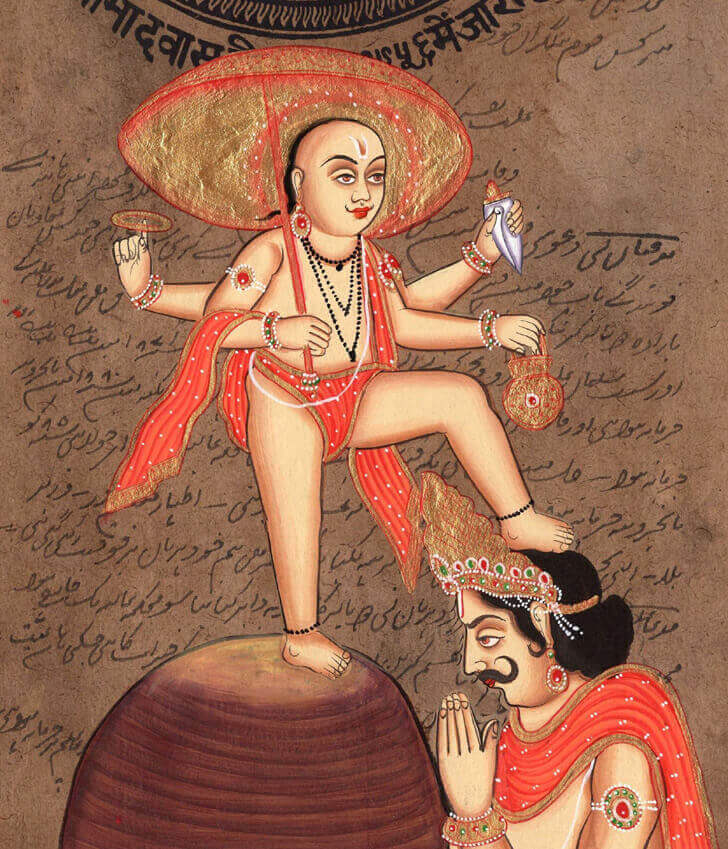
The fifth incarnation of Lord Vishnu is Vamana, the dwarf. It is the first incarnation of the Treta Yuga. According to the Bhagavata Purana, Lord Vishnu took this avatar to win back Lord Indra's powers and the kingdom of heaven from King Bali. The legend of Lord Indra and King Bali is narrated below.
King Bali conquered the gods through great religious practice and austerity. He drove Lord Indra out of the kingdom of heaven. Lord Indra went to Lord Vishnu and asked for his help to defeat King Bali and regain his place among the gods in heaven. Lord Vishnu accepted his appeal and took birth as a dwarf Brahmin. In the form of Vamana, the Brahmin, Lord Vishnu went to King Bali's sacrificial ceremony. The king deeply respected the Brahmin and invited him to ask for anything he wished.
The Brahmin Vamana asked King Bali to grant him as much land as he could cover in three steps. Bali's guru, Shukracharya, recognised the Brahmin as Lord Vishnu and warned the king, but in vain: Bali gave his word. Then Vamana grew to a cosmic size. With his first step he covered the earth and with his second the heavens, which were returned to Lord Indra. To fulfil his promise, Bali offered his head for Vamana's third step, and Vamana sent him to Sutala, in the netherworld. Vamana enlightened Bali that pride and wealth are temporary and fleeting, and quickly disappear. Some people believe that King Bali returns to earth every year. The Onam festival is celebrated to welcome and honour King Bali on his return to his lost kingdom.
Iconography: Vamana and Trivikrama
Vamana is shown as a young dwarf Brahmin boy carrying an umbrella (chhatra) and a water pot (kamandalu), wearing the sacred thread. He is often shown standing before King Bali with his palm held out to receive the gift of land.
His second form is Trivikrama, "the one who took three great strides". Here the Lord grows to a cosmic size, with one foot on the earth and the other raised high into the heavens. Famous Trivikrama carvings can be seen in the Badami cave temples in Karnataka and at Mamallapuram in Tamil Nadu. According to tradition, when the raised foot reached Brahmaloka, Lord Brahma washed it, and that water became the holy river Ganga.
Symbolism and Lessons of the Vamana Avatar
- Humility before power: the mightiest king of the three worlds was humbled by a small boy, a reminder that pride and wealth do not last.
- Keeping one's word: King Bali kept his promise even after his guru warned him, and he is honoured for this generosity to this day.
- Complete surrender: by offering his own head for the third step, Bali gave the Lord everything he had. According to the Bhagavata Purana, Lord Vishnu was pleased, sent Bali to rule the lower world of Sutala and promised to protect him there.
- Dharma restored without war: the heavens were returned to Lord Indra through a gift, not a battle.
Temples, Vamana Jayanti, Onam and Thursday Worship
Vamana Jayanti is celebrated on the Dwadashi (twelfth day) of the bright fortnight of Bhadrapada. Devotees fast, worship an image of Vamana and give charity (daan), in keeping with the spirit of the story.
In Kerala, Onam is celebrated in the Malayalam month of Chingam and reaches its peak on Thiruvonam day. The Thrikkakara Vamanamoorthy Temple near Kochi, where Vamana is the main deity, is closely linked with the festival. Other important temples include the Ulagalantha Perumal Temple in Kanchipuram, where the Lord is worshipped as Trivikrama, and the Vamana Temple at Khajuraho. In many parts of India, King Bali is also remembered on Bali Pratipada during Diwali.
Thursday worship connects naturally with Vamana. Brihaspati is the guru of the gods, while Shukracharya, who warned Bali, is the guru of the asuras. The story shows that good counsel matters, but devotion and surrender to Lord Vishnu matter most. On Thursdays, devotees offer yellow flowers, bananas and chana dal to Lord Vishnu, read the Vamana story and practise giving to others, as King Bali did.
भगवान विष्णु का पाँचवाँ अवतार वामन है, जो एक बौने ब्राह्मण के रूप में प्रसिद्ध है। यह त्रेता युग का पहला अवतार है। भागवत पुराण के अनुसार, भगवान विष्णु ने राजा बलि से भगवान इंद्र की शक्तियाँ और स्वर्ग का राज्य वापस दिलाने के लिए यह अवतार लिया। भगवान इंद्र और राजा बलि की कथा नीचे वर्णित है।
राजा बलि ने महान धार्मिक साधना और तपस्या के बल पर देवताओं पर विजय प्राप्त की। उसने भगवान इंद्र को स्वर्ग के राज्य से बाहर निकाल दिया। भगवान इंद्र भगवान विष्णु के पास गए और उनसे अनुरोध किया कि वे राजा बलि को हराने और स्वर्ग में देवताओं के साथ अपना स्थान वापस पाने में उनकी मदद करें। भगवान विष्णु ने उनका अनुरोध स्वीकार कर लिया और एक बौने ब्राह्मण के रूप में जन्म लिया। वामन ब्राह्मण के रूप में भगवान विष्णु राजा बलि के यज्ञ में गए। राजा ने ब्राह्मण का बहुत सम्मान किया और उनसे इच्छानुसार कुछ भी माँगने को कहा।
ब्राह्मण वामन ने राजा बलि से आग्रह किया कि वह उन्हें उतनी भूमि दान दे, जितनी वे तीन पग में नाप सकें। बलि के गुरु शुक्राचार्य ने ब्राह्मण को भगवान विष्णु के रूप में पहचान लिया और राजा को चेताया, पर व्यर्थ: बलि ने वामन को वचन दे दिया। तब वामन ने विराट रूप धारण किया। पहले पग से उन्होंने पृथ्वी और दूसरे पग से स्वर्ग नाप लिया, जिन्हें भगवान इंद्र को लौटा दिया गया। अपना वचन पूरा करने के लिए बलि ने तीसरे पग के लिए वामन के आगे अपना सिर प्रस्तुत कर दिया, और वामन ने उन्हें पाताल के सुतल लोक भेज दिया। वामन ने बलि को समझाया कि अभिमान और धन अस्थायी और क्षणभंगुर हैं, जो जल्दी ही नष्ट हो जाते हैं। कुछ लोगों का मानना है कि राजा बलि हर साल पृथ्वी पर लौटते हैं। ओणम का त्योहार राजा बलि के अपने खोए हुए राज्य में लौटने पर उनके स्वागत और सम्मान में मनाया जाता है।
वामन और त्रिविक्रम का स्वरूप
वामन भगवान को एक बौने ब्राह्मण बालक के रूप में दिखाया जाता है, जो हाथ में छत्र और कमंडल लिए हुए हैं और जनेऊ धारण किए हुए हैं। उन्हें अक्सर राजा बलि के सामने भूमि का दान लेने के लिए हथेली आगे बढ़ाए खड़ा दिखाया जाता है।
उनका दूसरा रूप त्रिविक्रम है, अर्थात "तीन विशाल पग भरने वाले"। इस रूप में भगवान ब्रह्मांड जितने विशाल हो जाते हैं, उनका एक पैर पृथ्वी पर होता है और दूसरा ऊपर स्वर्ग तक उठा होता है। त्रिविक्रम की प्रसिद्ध नक्काशियाँ कर्नाटक के बादामी गुफा मंदिरों और तमिलनाडु के महाबलीपुरम में देखी जा सकती हैं। परंपरा के अनुसार जब भगवान का उठा हुआ पैर ब्रह्मलोक पहुँचा, तो भगवान ब्रह्मा ने उसे धोया, और वही जल पवित्र गंगा नदी बना।
वामन अवतार का प्रतीकात्मक अर्थ और शिक्षा
- शक्ति के सामने विनम्रता: तीनों लोकों के सबसे शक्तिशाली राजा को एक छोटे-से बालक ने विनम्र बना दिया। यह याद दिलाता है कि अभिमान और धन सदा नहीं रहते।
- वचन का पालन: गुरु के चेताने के बाद भी राजा बलि ने अपना वचन निभाया, और अपनी इस उदारता के लिए वे आज भी सम्मान से याद किए जाते हैं।
- पूर्ण समर्पण: तीसरे पग के लिए अपना सिर प्रस्तुत करके बलि ने अपना सब कुछ भगवान को अर्पित कर दिया। भागवत पुराण के अनुसार भगवान विष्णु प्रसन्न हुए, उन्होंने बलि को सुतल लोक का राज्य दिया और वहाँ उसकी रक्षा का वचन दिया।
- बिना युद्ध के धर्म की स्थापना: स्वर्ग का राज्य युद्ध से नहीं, बल्कि दान के माध्यम से भगवान इंद्र को वापस मिला।
मंदिर, वामन जयंती, ओणम और गुरुवार की पूजा
वामन जयंती भाद्रपद मास के शुक्ल पक्ष की द्वादशी को मनाई जाती है। इस दिन भक्त व्रत रखते हैं, वामन भगवान की प्रतिमा की पूजा करते हैं और कथा की भावना के अनुरूप दान करते हैं।
केरल में ओणम मलयालम महीने चिंगम में मनाया जाता है और थिरुवोणम के दिन अपने चरम पर पहुँचता है। कोच्चि के पास स्थित त्रिक्काकरा वामनमूर्ति मंदिर, जहाँ वामन भगवान मुख्य देवता हैं, इस त्योहार से गहराई से जुड़ा है। अन्य प्रमुख मंदिरों में कांचीपुरम का उलगलंद पेरुमल मंदिर, जहाँ भगवान की पूजा त्रिविक्रम रूप में होती है, और खजुराहो का वामन मंदिर शामिल हैं। भारत के कई हिस्सों में दीपावली के समय बलि प्रतिपदा पर भी राजा बलि को याद किया जाता है।
गुरुवार की पूजा वामन अवतार से सहज रूप से जुड़ती है। बृहस्पति देवताओं के गुरु हैं, जबकि बलि को चेताने वाले शुक्राचार्य असुरों के गुरु हैं। यह कथा बताती है कि अच्छी सलाह का महत्व है, लेकिन भगवान विष्णु के प्रति भक्ति और समर्पण सबसे ऊपर है। गुरुवार को भक्त भगवान विष्णु को पीले फूल, केले और चने की दाल अर्पित करते हैं, वामन अवतार की कथा पढ़ते हैं और राजा बलि की तरह दूसरों को दान देने का अभ्यास करते हैं।